Spaces as good practice
Spaces as an example of good practice for strategic development of teaching in the digital age in der Showroom of the Hochschulforum Digitalisierung
THspaces
We are excited as DOLL to be part of the implementation and the roll out of the Social Learning Environment Spaces throughout the entire TH Köln.
Dr. Elisabeth Kaliva

Elisabeth Kaliva is the scientific lead of the Digital Open Learning Lab (DOLL) at the Köln International School of Design (KISD) of TH Köln. She is responsible for the research, conception and implementation of blended and seamless learning scenarios within the open source Social Learning Environment»Spaces«, which she co-developed. She is also the expert project leader in the university-wide implementation of Spaces at TH Köln. Furthermore she has a lectureship at the Learning Lab of the University Duisburg-Essen.

After her diploma in computer science and her master’s degree in Educational Media at the University of Duisburg-Essen, Elisabeth Kaliva received her doctorate from Prof. Dr. Michael Kerres. Her dissertation examines the didactic implications of digital project-based learning scenarios. Elisabeth Kaliva has many years of experience in design education and social learning. Her research focuses on how digital innovations support and change social learning in higher education.

Contact

Köln International School of Design
Ubierring 40
50678 Köln
Room 124

elisabeth.kaliva@th-koeln.de
+49(0)221 | 8275-3169

Collaborative knowledge and open source

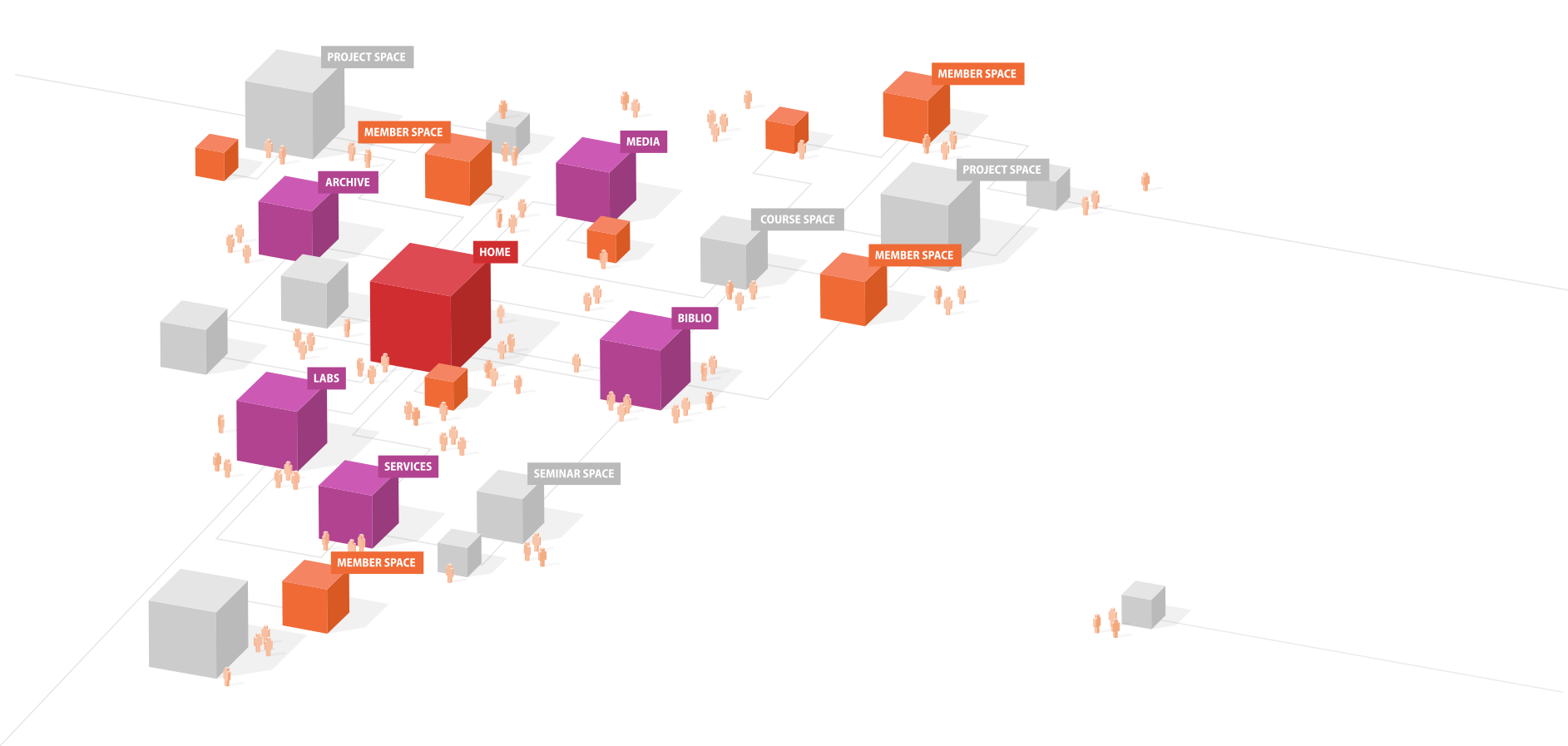
All actions initiated and performed in Spaces expand the digital knowledge base. Open data and exchange formats enable the flexible handling of data that can be accessed and managed in different, even external sources. Digital services such as an archive, a video platform and an online bibliography are offered in Spaces. The archive contains project, bachelor and master theses that are tagged and accessible for all members of the community.
Spaces is based on the open source weblog and publishing system WordPress. Building on this, a social learning environment was created with numerous self-developed plugins and themes. WordPress is very easy to deploy and extend for both users and developers. WordPress pays special attention to open web standards and has a very lively developer community. In order to make a contribution, the themes and plugins created for Spaces will be made available to the Open Source Community as soon as possible.

Advanced digital profiles through the Study Journal

All members of the community have an individual profile as their virtual presence in the community. This digital profile represents a part of the learning biography of each user. Personal information, such as name, email, telephone, semester, links to the social network and other links are displayed and can easily be edited by the user. The profile page also shows the student’s “Study Journal”. This is an e-portfolio in which the students document their attended courses, reflect their personal study goals, and receive feedback from lecturers or peers. The Study Journal documents the individual learning of students and supports the development of a high-quality competence-oriented study profile. This fosters the collaboration within the Spaces community by highlighting both the personal and professional perspectives of each student.

Mutual support and open communication

Each digital learning room in Spaces extend the feedback, reflection and support options of students. They do not have to present their activities exclusively in a physical space, but can initiate and present them independent of place and time online and receive feedback subsequently. In doing so, Spaces creates a flexible, but secure surrounding on which lectures, or peers can follow, support, and comment on current common learning activities.
Lecturers, students, and employees can publish messages, tips, hints, questions or appointments in a central »stream« on the start page of Spaces. The Spaces community heavily uses this common social media feature. The Spaces homepage is the main information and contact point and, at the same time, a window into the current teaching and learning activities in the Spaces community.

Networked collaboration in the community

Spaces supports the development of a vibrant digital network of lectures and students. Through their activities, participants shape a community in which ideas, research results, project, seminar and research work can be presented, discussed, and documented. The platform allows students to document their learning process and to involve among and inspire each other. This openness is not just limited to the internal community of KISD. External cooperation partners such as international universities, organizations, and companies can also be added into Spaces and thus become part of the learning and research community. This creates an open collaboration environment in which hierarchical and static group boundaries dissolve and new social and collaboration networks emerge.

IFSspaces
We are happy to announce that the International Film School (IFS) in Cologne will also use the as Social Learning Environment Spaces in the future.
Space at the GMW 2018
In the autumn of 2018, we presented the results of the evaluation of the prototypical use of Spaces in other faculties of the TH Cologne at the conference of the »Gesellschaft für Medien in der Bildung« (GMW).
Spaces at the TH Köln
In the winter semester 2017 spaces was prototypically used and evaluated in a pilot project in different faculties of the TH Cologne.

Spaces is a Social Learning Environment (SLE) which has been developed by KISD – Köln International School of Design (Faculty of Cultural Studies, TH Köln, University of Applied Sciences) since 2008. It offers a communication platform, facilitates the organization of learning, and allows students to work together in a digital learning network. Students and teachers present their project, seminar or research work, share their research results, discuss online, and mutually support each other.

Digital Open Learning Lab (DOLL)

doll@kisd.de

TH Köln
Köln International School of Design
Ubierring 40,

50678 Köln
Room 124


KISDspaces

Spaces is a Social Learning Environment (SLE) which has been developed by KISD – Köln International School of Design (Faculty of Cultural Studies, TH Köln, University of Applied Sciences) since 2008. It offers a communication platform, facilitates the organization of learning, and allows students to work together in a digital learning network. Students and teachers present their project, seminar or research work, share their research results, discuss online, and mutually support each other.

The Digital Open Learning Lab is ab interdisciplinary Lab where innovative concepts for supporting digital competence-oriented teaching are designed and researched. In the Digital Open Learning Lab applications are developed iteratively.  They are explored in real-world learning situations immediately, evaluated,  improved and reimplemented.  The activities of the Lab aim to increase the quality and flexibility of teaching and learning in project- and research based learning scenarios . Flat hierarchies promote students’ self-determined participation and support the development of a participatory culture within our digital Campus and Community.  Students help to shape the implementation process and the digital applications intensively and act as multipliers. They are involved in all processes as equal members of the Lab which takes  their particular view of learning and teaching into account. This is essential  for a better acceptance  and an active student participation in the developed digital learning platforms and tools.

KISD Köln International School of Design
Ubierring 40
50678 Köln
Germany
Phone: +49 (0)221 8275-3607
Fax: +49 (0)221 8275-3458
Contact

The Köln International School of Design is an academic institute of TH Köln. The TH Köln (Technische Hochschule Köln) is a corporate body under public law funded by the Federal Republic of Germany and legally represented by Prof. Dr. Klaus Becker.

Responsible Ministry:
Ministry of Culture and Science of North Rhine-Westphalia
Völklinger Straße 49
40221 Düsseldorf
Phone: +49 (0)211 896-03 / -04
Fax: +49 (0)211 896-4555 and -3220

The Köln International School of Design maintains and develops Spaces independently.

Technical Realisation
Digital Open Learning Lab

Photos
©Michaela Patschurkowski, KISD Photostudio


Please contact clemens.wahlig@th-koeln.de.

Where do I login?

There are different options for different people

  • Use “Login with your campusID” if you have a th-koeln email (jane@th-koeln.de or john@smail.th-koeln.de).
  • Use “Local login” if you don’t have a th-koeln email.
  • Check your password. You might want to reset it (see below)
  • Is this the right Spaces instance? There is another one called TH-Spaces (which is not only used by KISD but by the whole TH-Köln).
  • I’m an alumni and my campusID expired. See below “I don’t have a campusID any more”.
  • Contact doll@kisd.de if nothing helps.
What is my campusID? Do I have a campusID?

If you are a student you should have one.
It’s the first letter of your first name, followed by max 7 letters of your last name. So for “Jane Doe” it would be “jdoe”. More here.

If you are a guest-lecturer you can sign in via. “Local Login”.

I forgot my Password. What now?

Depending on your account you have two options to reset your password. You can also use your secondary email (if you have one set in your profile).

I don’t have a campusID any more (because I’m an alumni or no longer study/work here)
  • Go to “local login”.
  • Click on “Lost your password?”.
  • Use the “Secondary email” you added in your profile for password-recovery.
  • Follow the instructions to set a new password.
  • You can now always use “Local Login” and your the password you set.

No query required.