

30.10.2026
Description - EN
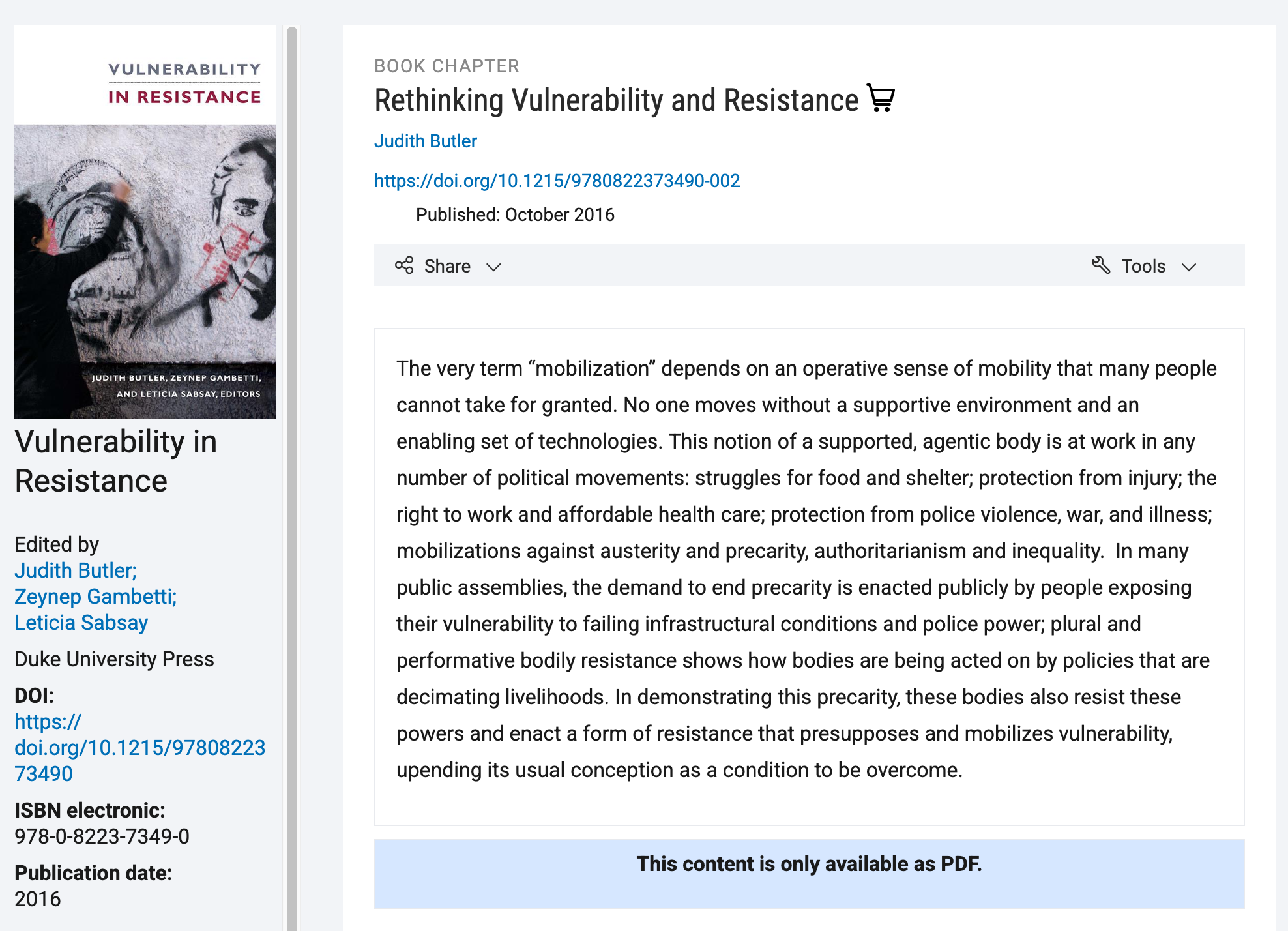
The project takes as its starting point Judith Butler’s reflections on vulnerability and resistance (2016) and the related text *Rethinking Vulnerability and Resistance*. Butler describes vulnerability not as an individual weakness, but as something that is shaped by social, material, economic, political, and discursive infrastructures. At the same time, dependencies can become the starting point for collective action and resistance.
In a very short time, each student will use this content as base to explore their own position—on care, vulnerability, dependence, visibility, the public sphere, work, access, protection, or resistance—and translate it into an independent audiovisual short and conceptual film.
(A)Infrastructures of Care will be a series of experimental motion design clips that utilize conceptual filmmaking, typography, poetry, and visual abstraction to narrate your positions and express your voice. We work with montage, rhythm, language, sound, and simple motion techniques, exploring how design not only represents something but also develops an attitude and establishes connections across time.
In this process, the sounding moving image becomes a form of thought and narrative: How can an infrastructure be made visible or audio-visually tangible? How can vulnerability be formally translated without illustrating it? And how does a theoretical position become a distinct visual language that moves the viewer?
The series is scheduled to be shown later at the Lucid Dream Festival 2027 in Sankt Pölten, as well as at Republica 2027.
This project is specifically designed for master’s students in the Visual Cultures & Politics and Material Systems and Lab Culture clusters, as well as for students who have already gained some experience in the field of Image & Motion and wish to build on it. Prior knowledge in working on timelines, with video and sound is adorable, but not a must. Availability (presense!), reliability and accountability – especially in case of team work– is must though.
Dates: We meet daily from 10am-4pm in our workspace, the MXL/R404.
Bring your (capable) laptops and have Adobe Suite installed or any other video making tool alternatives like Affinity, Cavalry, Blender etc.. – Have also a sound software like Audacity installed. If you have tech questions, see us at the MXL or talk to Stefan Terlinden in advance.
Beschreibung - DE

Ausgangspunkt des Projekts sind Judith Butlers Überlegungen zu Verletzlichkeit und Widerstand (2016) und der damit verbundene Text Rethinking Vulnerability and Resistance. Butler beschreibt Verletzlichkeit nicht als individuelle Schwäche, sondern als etwas, das durch soziale, materielle, ökonomische, politische und diskursive Infrastrukturen mitbedingt wird. Zugleich können Abhängigkeiten zum Ausgangspunkt kollektiver Handlung und Widerstand werden.
In kürzester Zeit adressiert jede*r Studierende auf dieser Basis eine eigene Position: zu Care, Vulnerabilität, Abhängigkeit, Sichtbarkeit, Öffentlichkeit, Arbeit, Zugang, Schutz oder Widerstand – und übersetzt sie in eine eigenständige audiovisuelle kurzfilmische Arbeit.
(A)Infrastructures of Care wird eine Serie aus experimentellem Motion Design Clips die Conceptual Filmmaking, Typografie, Poesie und visuelle Abstraktion nutzen, um diese Positionen zu erzählen. Wir arbeiten mit Montage, Rhythmus, Sprache, Sound und einfachen Bewegungstechniken und untersuchen, wie Gestaltung nicht nur etwas darstellt, sondern eine Haltung entwickelt und Zusammenhänge über Zeit herstellt.
Das klangunterstützte Bewegtbild wird dabei zur Denk- und Erzählform: Wie lässt sich eine Infrastruktur sichtbar oder erfahrbar machen? Wie kann Verletzlichkeit formal übersetzt werden, ohne sie zu illustrieren? Und wie wird aus einer theoretischen Position eine eigene visuelle Sprache, die emotional berührt?
Die Serie soll später auf dem Lucid Dream Festival 2027 in Sankt Pölten, sowie der Republica 2027 gezeigt werden.
Diese Projekt ist speziell für Masterstudierende aus dem Visual Cultures & Politics, sowie Material Systems and Lab Culture Cluster, sowie für Studierenden, die schon erste Erfahrungen im Bereich Image & Motion gesammelt haben und diese vertiefen wollen. Vorkenntnisse im Umgang mit Zeitleisten, Videos oder Sound sind von Vorteil, aber keine Voraussetzung. Verfügbarkeit (Anwesenheit!), Zuverlässigkeit und Verantwortungsbewusstsein – insbesondere bei der Teamarbeit – sind jedoch ein absolutes Muss.
Termine: Wir treffen uns täglich von 10:00 bis 16:00 Uhr in unserem Arbeitsraum, dem MXL/R404.
Bringt eure (leistungsfähigen) Laptops mit und sorgt dafür, dass die Adobe Suite oder eine alternative Videobearbeitungssoftware wie Affinity, Cavalry, Blender usw. installiert ist. – Außerdem solltet ihr eine Audiobearbeitungssoftware wie Audacity installiert haben. Bei Fragen kommt im Vorfeld bittte im MXL vorbei oder wendet euch an Stefan Terlinden.
30.10.2026